Conveyor belt maintenance in industry: saving time and money

Conveyor belt maintenance in industry: saving time and money

Jun 11, 2026 News

Proper conveyor belt maintenance in industry directly determines a line's productivity. On a manufacturing line, every hour of downtime runs into thousands of euros. Replacing a toothed belt is one of those maintenance tasks that look minor but can bring an entire line to a standstill for hours. Open-ended belts with a mechanical joint change all that: they get a line back into production within minutes, whereas a traditional welded belt calls for lengthy disassembly.

Key takeaway

An open-ended belt with a mechanical joint can be fitted in about 20 minutes by a single operator, with no line disassembly.
    -> Less downtime means fewer production losses, plain and simple.

The real cost of a line stoppage

For a maintenance manager, the math is simple: as long as the line is stopped, it produces nothing yet keeps costing money. Staff wages, late deliveries, restarting the process, possible penalties: the bill climbs fast, and well beyond the price of the part being replaced.

According to a Siemens report, the world's 500 largest companies are estimated to lose close to 1.4 trillion dollars a year because of unplanned downtime, around 11% of their revenue. Another study finds that 68% of industrial companies suffer at least one unplanned breakdown a month. Cutting the duration of each intervention therefore becomes a very tangible way to save money.

Tip

Run the numbers on your own line. Multiply your hourly output by your unit margin, then by the number of hours a belt change currently takes. You get the true cost of the operation, far above the price of the part.

Why changing a welded toothed belt brings the whole line to a halt

This is where changing a toothed belt gets complicated with the closed polyurethane models that now equip a great many manufacturing lines, particularly in conveyor processes. Most are custom-made and delivered welded, hence closed. That closure, which gives them their strength, becomes a handicap when maintenance time comes.


To slide a closed belt onto its shaft, you first have to free the shaft itself. In practice, that means:

  • removing the mechanical parts blocking access to the shaft,
  • unshafting the line, a step that is often long and delicate,
  • shutting down the whole process, including the other belts running alongside.


It is this last point that weighs the most. On many installations, several belts run side by side. Replacing just one of them then forces you to stop and unshaft the entire line, even when the other belts are in perfect condition.

Changing a belt on a production line with PINLOCK: a mechanical joint, no welding

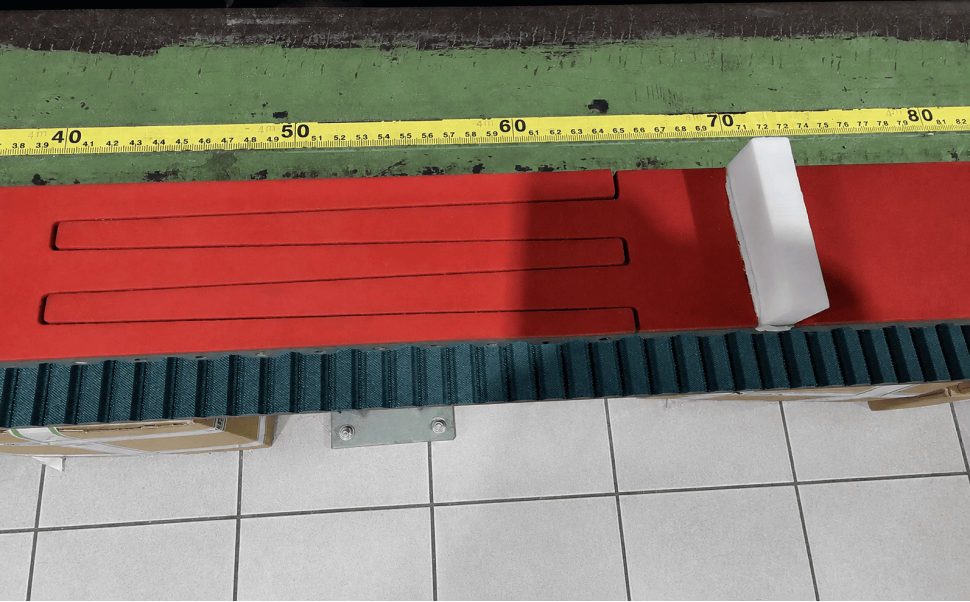
For changing a belt on a production line, Binder Magnetic offers a different approach with PINLOCK  belts: delivered open-ended, with no thermoplastic weld, together with a mechanical assembly kit. Instead of threading a closed loop around the shaft, the operator sets the belt in position, then closes the joint mechanically, right on the line.

The result is measured in time: this toothed belt change can be carried out by a single operator in about twenty minutes, with no unshafting. The neighboring belts stay in place, and the line restarts far sooner.

Steps for a replacement with a PINLOCK belt:

  1. Stop the affected zone, without removing the shaft.
  2. Remove the worn belt.
  3. Position the open-ended belt along its path.
  4. Close the joint using the mechanical assembly kit.
  5. Check the tension and restart production.
  6.  

Replacing a toothed belt: welded versus open-ended, what really changes

The table below sums up the differences a maintenance team sees when replacing a toothed belt.

Criterion

Welded belt (closed)

Open-ended PINLOCK belt

Fitting

Line disassembly (unshafting)

No line disassembly

Intervention time

Several hours

About 20 minutes

Staff required

Often several people

A single operator

Production line

The entire production line is shut down

The worn belt is replaced without touching the other belts on the line


Who is affected?

PINLOCK belts come in the T10, T1/2, AT10 and AT20 pitches. These profiles cover a large share of the conveyor applications now fitted with welded belts. In other words, many existing lines can switch to a mechanical joint without redesigning their whole layout.

Note

Not sure whether your installation is compatible? The profile, pitch and width of your current belt are usually enough to tell. Binder Magnetic's technical teams can help you identify the open-ended belt that matches your process.

Open-ended toothed belt replacement: direct benefits for maintenance teams

Beyond the raw time saving, open-ended toothed belt replacement changes daily life for maintenance staff. The job becomes simpler, safer and far less dependent on having a full team available.

  • Fewer people tied up : a single operator is enough, instead of tying up several technicians.
  • Plannable interventions : a 20-minute replacement slots easily into a short maintenance window.
  • A more productive line : fewer hours of downtime means more useful production time.
  • Targeted maintenance : you replace the worn belt without touching the other belts on the line.

Binder Magnetic's technical teams are here to work out with you the belt that will cut your intervention times, and your costs.

Recent Articles

Recent Articles

Tags Post

Tags Post