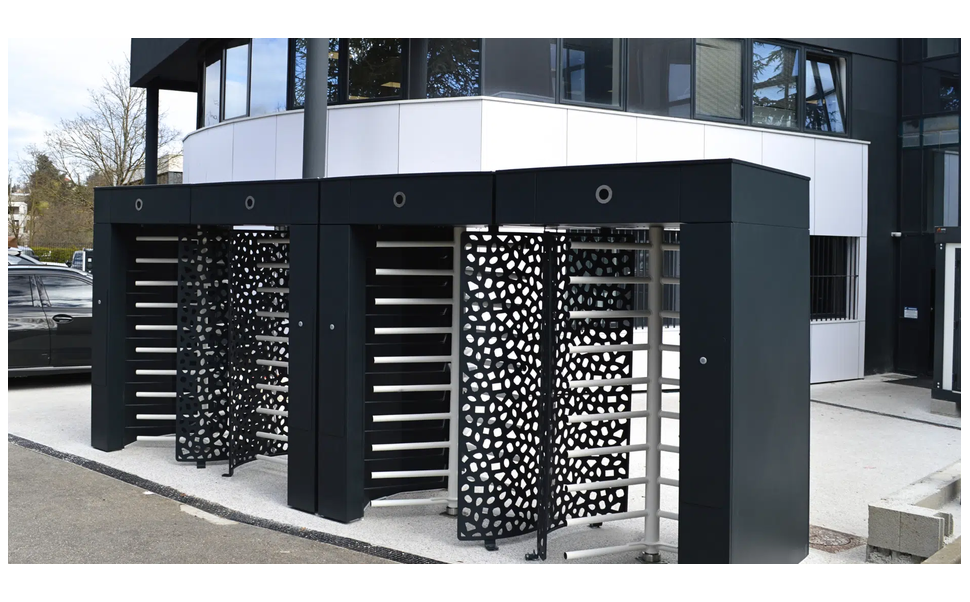
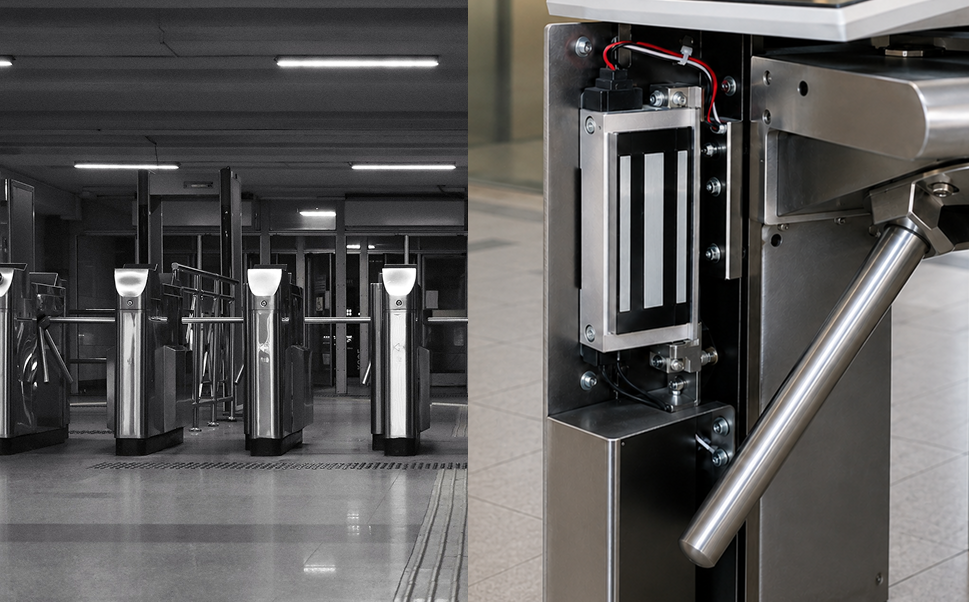
An electromagnetic security system can hold, lock, release, or move a mechanism using an electrical control signal. In an industrial facility, data center, or sensitive infrastructure, every access point represents a potential vulnerability. This is exactly where electromagnets and solenoids come into play. Integrated into electromagnetic locks, turnstiles, fire door holders, or pedestrian gates, they provide reliable, immediate locking without the wear constraints of traditional mechanisms.
Their value lies in their fast actuation, integration with automation systems, and the ability to precisely adapt their operation to the system's expected behavior, including during a power outage.
The global access control market, estimated at $12.8 billion in 2025 (Research Nester), is expected to grow by more than 8% per year through 2035. This trend reflects growing demand for fast, connected solutions that comply with current regulations.
How does an electromagnet work in a security system?
An electromagnet uses a coil that, when energized, generates a magnetic field capable of attracting or moving a movable core to lock or release a safety device.
Depending on the design, the electromagnet operates in fail-safe mode (unlocks during a power outage, as required by fire safety standards) or in fail-secure mode (locking is maintained without power, for restricted-access areas).
With a single-acting electromagnet, the core becomes free again when power is cut. Other technologies, by contrast, can maintain a position without power. This is particularly the case with monostable and bistable electromagnets using permanent magnets.
In a security application, the expected behavior during a power loss must therefore be defined from the outset. A fire door held open, for example, does not have the same requirements as a lock designed to prevent access to a sensitive area.
This choice determines the type of product selected: holding magnets for fire safety, electromagnetic security lock or electric strike for access control, electromagnetic lock for high-traffic exits.
Five benefits of electromagnet-based security
Electromagnet-based security offers technical advantages that purely mechanical devices cannot provide.
Fast response
Electromagnetic actuation provides very short response times. Depending on the design and model selected, they can be on the order of a few dozen milliseconds.
This responsiveness is especially valuable when a mechanism must be released, locked, or repositioned quickly after receiving an electrical signal.
Long service life
By limiting friction between moving parts, an electromagnet reduces wear and extends maintenance intervals, a direct economic benefit for facility managers.
High holding force
An electromagnet's force can be sized based on the force required to move, hold, or lock the mechanism.
However, selecting the highest value is not enough. The force actually available depends in particular on stroke, core position, mounting, and any external forces applied to the system.
Easy integration
Controlled by a simple electrical signal, the electromagnet integrates naturally with PLCs, fire safety systems (SSI), or access management software.
Low power consumption
Power consumption depends directly on the type of electromagnet and its operating mode.
In a monostable design, for example, an electrical pulse attracts the core before a permanent magnet holds it in position without continuous power. A new pulse with reverse polarity then releases it. This technology therefore limits power-on time as well as coil heating.
Key takeaway
At the European level, EN 1155 and EN 14637 standards govern fire door hold-open devices. Fail-safe operation is mandatory in ERP facilities.
In the United States, fire door hold-open and electromagnetic locking systems are governed by standards such as NFPA 80 and applicable building and fire codes, including the IBC. Hold-open devices must release to allow fire doors to close automatically upon smoke detection, fire alarm activation, or loss of power, depending on the application and local code requirements.
Main applications of electromagnetic components in security
Electromagnet-based door security is one of the most common applications, but electromagnetic components are used in many protection, access control, and automation systems.
|
Application |
Function |
Function |
|
Pedestrian flow control |
Actuating electromagnets, locks | Control the locking and unlocking of turnstiles, tripod turnstiles, or gates |
|
Access locking |
Electromagnetic locks, locks, electric strikes |
Secure a door, vestibule, or technical room |
|
Fire safety |
Electromagnetic door holders |
Hold a door open, then allow it to release when required by the safety system |
|
Asset protection |
Locks and electromagnetic devices | Secure safes, cabinets, or lockers |
|
Sensitive environments |
Electromagnets and holding devices adapted to site constraints |
Meet the specific requirements of industrial installations or regulated environments |
The solutions used depend in particular on the force required, operating frequency, installation environment, and expected behavior during a power outage.
Electromagnets are now used in systems from the world's leading manufacturers of turnstiles, gates, and access control barriers, whether for managing pedestrian flows in train stations and airports or protecting sensitive industrial sites.
How to choose the right security electromagnet
Choosing a security electromagnet starts with a simple question: does the component need to pull, push, hold, lock, or release a mechanism?
This function then determines several technical parameters.
|
Criterion |
Question to ask |
|
Function |
Does the component need to move, hold, or lock? |
| Behavior without power |
What should happen if power is lost? |
|
Force and stroke |
What force must be provided and over what distance? |
|
Duty cycle |
Is operation occasional, intermittent, or frequent? |
|
Mounting position |
Does the electromagnet operate horizontally or vertically? |
|
Space requirements |
How much space is available to integrate the component? |
|
Environment |
Are there temperature, vibration, dust, or ATEX atmosphere constraints? |
| Power supply and control |
What voltage and control method are available? |
This is where guidance from a specialist makes the difference.
Frequently asked questions about electromagnets in the security sector
What is the difference between fail-safe and fail-secure operation?
In fail-safe mode, the electromagnet releases the mechanism as soon as power is cut (the mode required for fire evacuation). In fail-secure mode, locking is maintained without power, which suits areas where preventing intrusion is the priority.
Which sectors use electromagnets in their security systems?
Commercial buildings, industry, transportation, defense, healthcare, and nuclear facilities use electromagnets in their security systems. Each environment imposes constraints (temperature, certification, operating frequency) that guide component selection.
Which electromagnetic products are used to secure a door?
Depending on the application, electromagnetic door holders (holding fire doors open), electromagnetic locks (high-traffic access control), electric bolt locks (occasional locking), or electric strikes (remote release of a mechanical latch) may be used. The choice depends on the required force, opening direction, and applicable standards.
When should a monostable electromagnet be used?
A monostable security electromagnet is particularly useful when a position must be maintained without continuous electrical power.
After the core is attracted, a permanent magnet holds it in position. Reverse-polarity power then releases it. This design reduces power-on time and heating while maintaining a stable position.
How do you choose an electromagnet for an ATEX environment?
In a potentially explosive atmosphere, selection should not be based solely on the product's mechanical or electrical performance. The component must be suitable for the relevant ATEX zone and the installation's specific conditions.
This constraint must therefore be incorporated when defining the specifications, and the selected product's compliance with the environment in which it will be installed must be verified.
Why work with a specialized supplier?
Sizing an electromagnet involves several interdependent parameters: stroke, force, duty cycle, power supply, mounting, and environment.
A specialist can analyze these data before selecting the appropriate technology. Binder Magnetic electromagnets are stated to comply with the DIN VDE 0580 manufacturing standard and RoHS.
Getting expert support when choosing an electromagnetic security solution
Choosing an electromagnetic component for a security application should not be left to chance. A sizing error can affect the available force, operating frequency, power consumption, or the mechanism's behavior during a power outage.
Binder Magnetic, a subsidiary of the BRECO Group and exclusive partner in France for KENDRION and NAFSA, offers a complete range of solenoids (simple operation, double maneuvering, monostable, bistable) and holding magnets, including ATEX versions.
Support is intended in particular for engineering departments and integrators that need to select or size a component based on specifications. With offices in Gennevilliers, Strasbourg, Angers, Lyon, and Toulouse, Binder Magnetic also provides local support throughout France. Binder Magnetic also serves customers in Belgium, Luxembourg and Switzerland.
Do you have an application to size? Contact the Binder Magnetic team and provide your requirements for function, force, stroke, power supply, operating frequency, and environment to identify the electromagnetic solution best suited to your project.