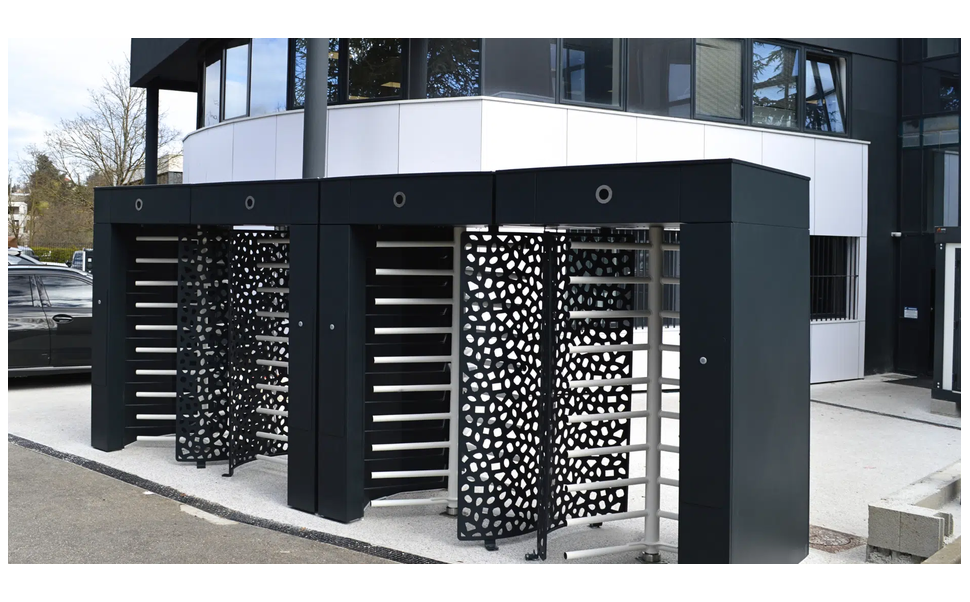
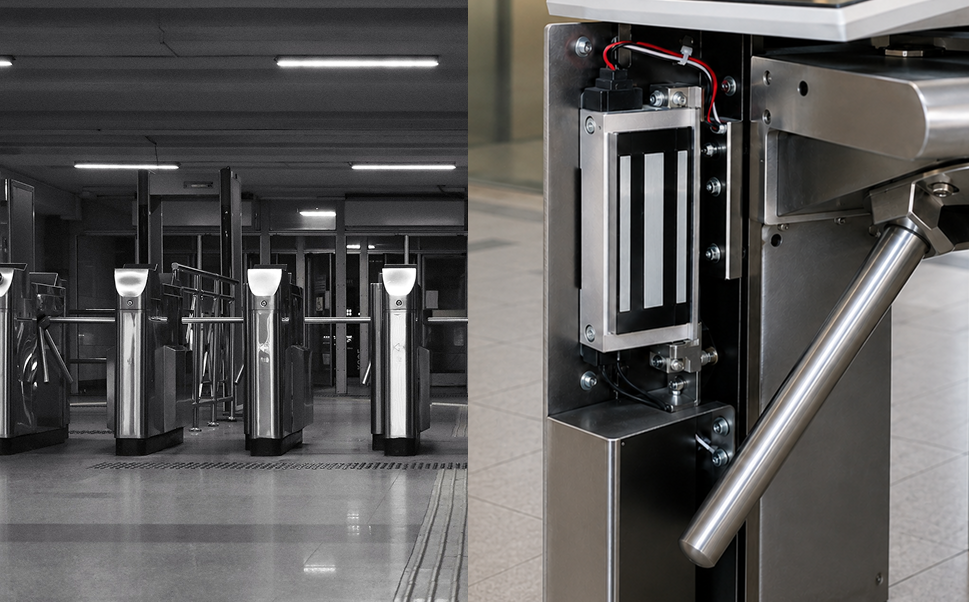
Access control has become an essential part of securing buildings, industrial sites, transportation infrastructure, and public spaces. Behind the systems users see - automatic doors, pedestrian gates, turnstiles, barriers, and locking devices - are mechanisms that must operate reliably, quickly, and repeatedly: electromagnetic brakes for access control.
In these applications, electromagnetic clutches and brakes play an essential role in managing and controlling mechanical motion. In particular, they can transmit or interrupt rotary motion, hold a mechanism in position, or stop equipment in response to signals from the access control system.
Choosing the right electromagnetic component is therefore important. The selection must take into account parameters such as the torque to transmit or hold, rotational speed, cycle frequency, response time, supply voltage, available space, and required safety level.
In this article, Binder Magnetic explains how electromagnetic clutches and brakes work and helps you choose the right solution for your application.
Electromagnetic brakes and clutches in security applications: how do they work?
An access control system must quickly determine whether a person is authorized to pass through an access point. That information must then be converted into a mechanical action: allow movement, block a mechanism, hold a position, or stop equipment.
This is precisely where electromagnetic brakes and electromagnetic clutches for access control systems come into play.
What is the role of an electromagnetic brake?
The electromagnetic brake holds rotating or translating components stationary. There are two main types:
-
Power-off brake: braking engages as soon as power is removed, under force generated by permanent magnets or springs. This configuration is preferred when safety requirements call for automatic locking in the event of a failure.
-
Power-on brake: braking occurs only when power is supplied. The passage is released if power is lost, helping facilitate emergency evacuation.
In an access control application, the brake can be used to:
-
hold a door or mechanism in position;
-
prevent a shaft from rotating;
-
stop motion quickly;
-
keep equipment locked when the motor is stopped;
-
secure an installation in the event of a power outage.
The choice between power-off and power-on operation depends directly on the required safety level and the desired behavior in the event of a power outage.
What about an electromagnetic clutch?
The electromagnetic clutch instantly engages or disengages transmission components. It allows drive only when access conditions are validated, ensuring smooth passage while preventing unauthorized operation.
It can quickly connect or disconnect two mechanical components without requiring the motor to come to a complete stop.
This technology is particularly useful when the system must perform fast, repetitive cycles.
In an access control system, a clutch can therefore be used to engage a mechanism only when access is authorized, then disengage it once the cycle is complete.
In practice, these two components are often used together within the same piece of equipment: the clutch transmits motion during passage, then the brake takes over to stop the arm or gate leaf cleanly once the cycle is complete, reducing mechanical jolts.
Key takeaway
The choice between a power-off brake and a power-on brake depends on the expected behavior during a power outage: safety locking or release for evacuation.
Performance designed for demanding environments
At a train station or stadium, access control systems may operate several thousand or even several million times over their service life. Electromagnetic brakes and clutches offer the advantage of electrical control and relatively easy integration into an automated system.
They can also provide short response times, good repeatability, and operation suited to modern automation systems.
For a bidirectional gate that must switch quickly between opening and locking, this responsiveness improves both traffic flow and user safety. Versions designed for intensive use can also withstand wide temperature ranges, an advantage in unheated concourses or outdoor access points exposed to the weather.
Mechanical components must therefore withstand:
-
repeated operating cycles.
-
frequent starts and stops.
-
load variations.
-
significant mechanical stresses.
-
high requirements for safety and availability.
Comparison: clutch vs. brake in access control
|
Criterion |
Electromagnetic brake |
Electromagnetic clutch |
|
Function |
Stop and lock |
Engage / disengage |
|
Typical use |
Locking a closed turnstile |
Driving a pedestrian gate |
|
Response time |
A few milliseconds |
|
When unpowered |
Locked or free (configurable) |
Free or engaged (configurable) |
|
Wear |
Very low |
Very low |
Integration with modern systems
These components connect to PLCs, RFID readers, biometric devices, and supervisory software. They can manage multiple modes without changing the mechanical design: free access, controlled passage, permanent locking, emergency evacuation, or bidirectional operation. This versatility simplifies design for engineering firms and inventory management for distributors. Control can be on/off, variable-voltage, or via a communication bus, simplifying integration with existing PLCs.
Electromagnetic clutches and brakes in security applications: main uses
-
Turnstiles and tripod turnstiles (train stations, subways, stadiums)
-
Motorized pedestrian gates (office buildings, corporate headquarters)
-
Pedestrian barriers (airports, transit areas)
-
Electromagnetic locks and locking devices
-
Electromagnetic door holders (fire safety)
-
Security vestibules (data centers, sensitive facilities)
-
Emergency exits, military vehicles, safes
For each of these applications, the brake or clutch must be sized according to the system's mechanical characteristics: torque, speed, inertia, cycle frequency, stopping time, and operating conditions.
How to choose the right component
Sizing is based on several criteria that should be evaluated during the design phase:
-
Required torque: matched to the inertia of moving components and the operating cycle rate.
-
Space constraints: access control equipment is compact, so the component must fit without compromising performance.
-
Behavior when unpowered: automatic locking or release, depending on the site's safety standards.
-
Service life: the component must withstand millions of cycles in very high-traffic environments.
-
Compliance: DIN VDE0580, RoHS, ATEX, depending on the industry.
Support from Binder Magnetic
Binder Magnetic offers a range of electromagnetic brakes and clutches, from low-torque solutions for lightweight turnstiles to heavy-duty versions for high-traffic barriers and security vestibules. Depending on project requirements, our technical team supports customers from component selection through integration, adjusting the footprint or torque as needed to match the site's mechanical constraints. This close support also makes it easier to replace a failed component in an installation already in operation.
Precision, fast response, durability, and ease of integration: electromagnetic brakes and clutches meet the needs of pedestrian access control applications. As this market continues to grow, choosing reliable, properly matched components helps distinguish solutions in the market while reducing maintenance costs.